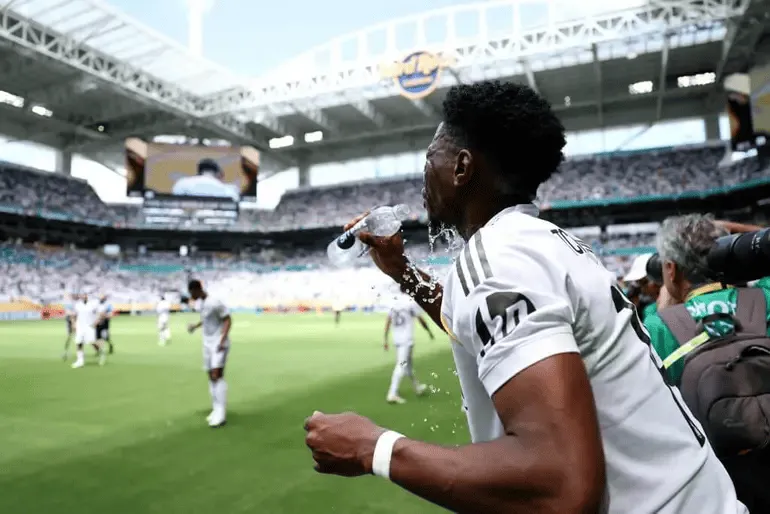
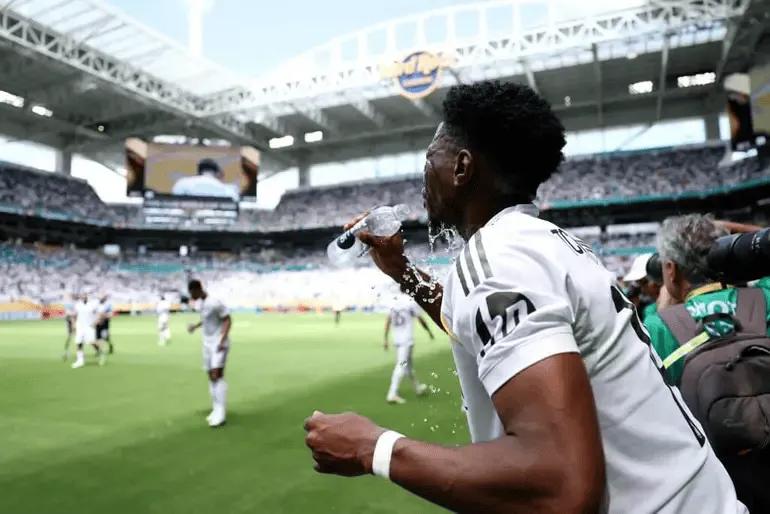
FIFA will allow broadcasters to air commercials during the "cooling breaks" in each half of every match at the 2026 FIFA World Cup.
FIFA announced last December that it would introduce a three‑minute break in each 45‑minute half of World Cup matches.The governing body said the move was for "player welfare" and stated that "the length of the break is not linked to weather or temperature, and the break will be decided by the referee for all matches".
FIFA officials have also discussed the change with broadcasting executives.Three sources, including one FIFA insider, confirmed that broadcasters will be allowed to run adverts during live coverage, much like during halftime or timeouts in basketball or rugby.
However, two sources said there will be restrictions on the practice.
Written guidelines show that broadcasters have been told ad breaks must not start within 20 seconds of the referee blowing for the pause, and must return to match coverage at least 30 seconds before play resumes.
This means they will have 2 minutes 10 seconds of advertising time.
Broadcasters are not obliged to cut fully to adverts.They can return to the studio and show pundits analysing the game.They can also keep showing the match feed, or shrink it and run adverts on part of the screen.(In that case, commentators can continue analysing the match, or adverts can also take over the audio signal.)
Sources said that if broadcasters do not cut fully to adverts, they may only sell such advertising slots to FIFA sponsors.
As football has become increasingly commercial, like other sports, this has sometimes become a point of contention for sponsors.Companies such as Coca‑Cola, which pay FIFA hundreds of millions of dollars annually for World Cup sponsorship, have placed great importance on their exclusive rights.Coca‑Cola would certainly object if a broadcaster such as Fox, which holds the English‑language World Cup rights in the US, sold in‑game advertising space to Pepsi.
As a result, advertising during cooling breaks will only be permitted for Coca‑Cola‑owned Powerade, not Pepsi‑owned Gatorade.Any split‑screen or full‑screen adverts shown next to or over match footage must be for FIFA partners.
On the other hand, sources said, if broadcasters switch to full‑screen adverts, they may sell those slots to anyone.Two senior industry figures believe FIFA sponsors will have priority, but one FIFA insider said the process will be open and transparent.
All of this is unprecedented in football.
Decades ago, the World Cup was mostly broadcast by public broadcasters, especially in Europe, many of which ran no adverts at all.Today, however, FIFA is increasingly selling rights to private television networks — all of which will be allowed to air commercials during player cooling breaks.
Inside stadiums, FIFA will control advertising during the breaks.
During last summer’s FIFA Club World Cup in the US, when temperatures rose to dangerous levels, player cooling breaks were held, and stadium big screens referred to them as "Gatorade Cooling Breaks".However, opening up the breaks to broadcasters could yield far more revenue, especially in the long term.
"If you’re FIFA and you decide to have these breaks, it’s simple arithmetic: is it more profitable to sell these breaks at a premium to [commercial] partners, or to give them back to broadcasters? In this case, the answer is clear," said Ricardo Fort, a senior sports sponsorship executive who has worked for Coca‑Cola and Visa."Broadcasters will make more money from such a break — and they will be willing to pay more for it."
The 2026 World Cup will be the first major football tournament to feature a three‑minute mid‑half break — though not the first to pause matches.Two months after FIFA announced the new rule, CONMEBOL, South America’s football governing body, introduced 90‑second cooling breaks in its club competitions, including the Copa Libertadores, also regardless of "temperature or weather conditions".
However, no TV adverts are shown during CONMEBOL’s 90‑second breaks.Under the rules, "cameras and microphones from CONMEBOL’s production team may approach the break area to capture images and sound, including any instructions from coaching staff to players".CONMEBOL can then sell those breaks to sponsors.
Whether 90 seconds or three minutes, the breaks also give coaches a chance to speak to players and adjust tactics.
Some broadcasters will view the breaks as "premium content" and may therefore be reluctant to cut away entirely for adverts.